| Summary: |
- Summary by:
- Pat Deveney
- Succession:
- Title:
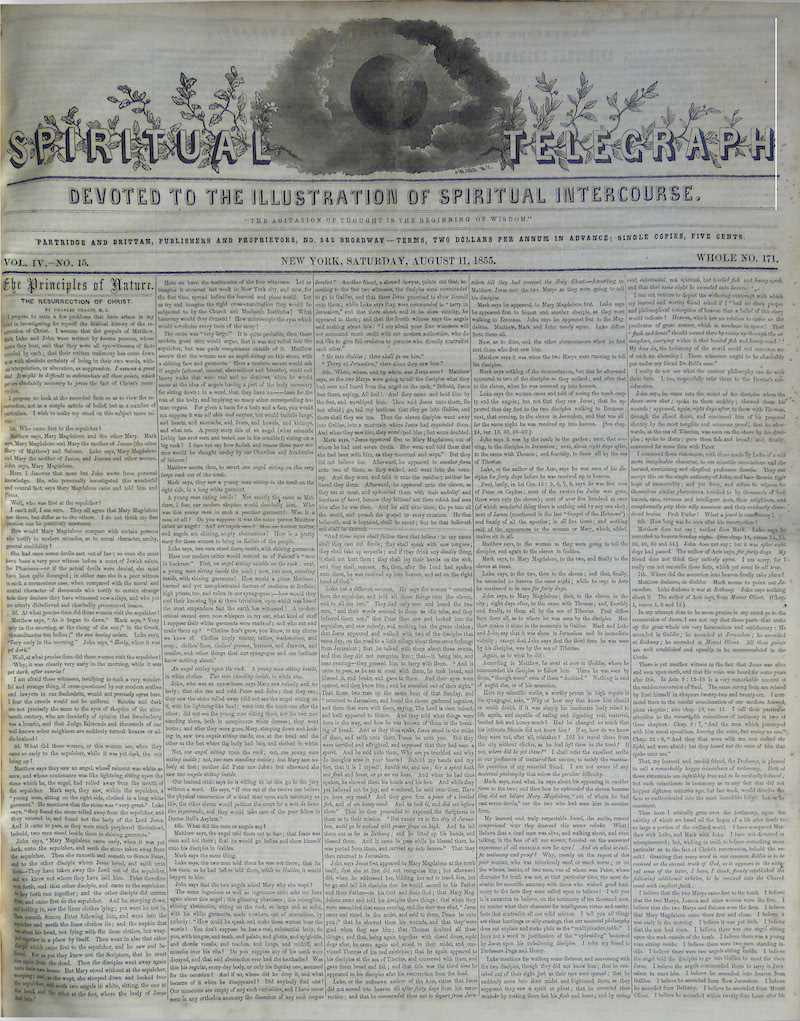
- Spiritual Telegraph, The.
- Subtitle:
- Devoted to the Illustration of Spiritual Intercourse.
- Motto:
- The Agitation of Thought is the Beginning of Wisdom
- Other Titles:
- Spiritual Telegraph and Fireside Preacher (beginning May 1, 1858)
- Published:
- 1852-1859
- Frequency:
- Weekly
- Location:
- New York, NY.
- Language:
- English.
- Editor(s):
- Samuel Byron Brittan (1815-1883), with A.E. Newton as associate editor from 1853.
- Publisher(s):
- Charles Partridge; after May 18, 1853 Partridge and Brittan; after April 18, 1857 Charles Partridge with (according to Allibone) La Roy Sunderland.
- Corporate Author:
- Succession:
- Succeeds: A New Leaf
Succeeded by: Spiritual Telegraph and Fireside Preacher->Herald of Progress (subscription list transferred after issue of February 25, 1860) - Description:
1/1, May 8, 1852-7/52, April 23, 1859 (Number 364). The renamed and revised Spiritual Telegraph and Fireside Preacher (q.v.) continued the original volume numbering until 8/44, February 25, 1860. 12 x 15 1/2, then with volume 2, 19 x 24, and then with volume 5, back to the smaller size. Originally 4, then 8, and finally 12 pages-which began to be numbered, sequentially across all issues annually, with volume two. Originally unpaginated. Three cents a copy; $1.50 a year (then in 1855, $2.00 a year). U. Clark's Spiritualist Register for 1858 claims a circulation for the Spiritual Telegraph of over five thousand. The Telegraph originated in the New York Conference for the Investigation of Spiritual Phenomena and reported that body's proceedings each week in the almost eight years that the journal was published. It is the first truly spiritualistic journal published in the United States, though the Univercoelum and the Spiritual Philosopher and others of more general nature antedate it. Though mild by even contemporary standards, the journal's "original goal of reporting spirit communication and furthering anti-credal reform" finally "aroused the emnity of all,"as the journal admitted in changing its editorial line in 1858 and taking up the new name of Spiritual Telegraph and Fireside Preacher. The "anti-credal reform" is scarcely apparent under the mass of reports of communications and the like, but the enormous importance of the journal today is its raw reporting of the doings and whereabouts of those who subsequently became famous in the ranks of spiritualism: P.B. Randolph; Emma Hardinge (and her Musical Academy); Thomas Lake Harris; W.R. Hayden (whose wife was among the first wave of American mediums to decamp for England); Dr. John A. Weisse (who intended to publish Higgins' Anacalypsis under the aegis of the Telegraph and later became a Vice-President of the Theosophical Society); H.S. Olcott (whose agricultural institute, "Olcott & Vail," was a regular advertiser); Stephen Pearl Andrews (who serialized his Universology); Cora L.V. Hatch; and Frances H. (Fanny) Green. Interspersed with accounts of "normative" American spiritualism are surprisingly early mentions of more traditional magical and oriental practices (such as scrying in ink) and intimations of occultism ("Apparitions of Living Persons") that the journal attempted to assimilate to spiritualism. Partridge & Brittan was dissolved in March 1857 (with Brittan sighing that his five years editing the Telegraph left him with "neither purse nor scrip") and Brittan resigned as editor to move to The Spiritual Age. The Telegraph ceased publication with 8/44 (number 408) on February 25, 1860, transferring its subscription list to Andrew Jackson Davis's new Herald of Progress. The Telegraph also appeared in compiled volumes of excerpts under the title of The Telegraph Papers (of which V1 (1853), V2 (1853), V3 (1854), V4 (1854), V5 (1855), V6 (1855) and V7 (1855) are available). S.B. Brittan was a Universalist minister who was enthusiastically welcomed the revelations of Andrew Jackson Davis, and edited The Univercoelum which promulgated Davis's ideas until the latter was accused of carrying an affair with a married woman in Brittan's own home. He then edited and largely wrote The Shekinah (devoted to "an Inquiry into the Spiritual Nature and Relations of Man"), probably with money borrowed from Charles Partridge, and in May 1852 was hired by Partridge to edit the Spiritual Telegraph. In May 1853, Brittan and Partridge entered into partnership, with Partridge supplying the money and Brittan contributing I.O.U.s for his share. For Partridge & Brittan, see the note under The Shekinah. Brittan was no fool, and tried to inculcate a spirit of healthy skepticism into the spiritualist movement in the early months of its existence: "A rational skepticism may serve as an incentive to profound thought and deliberate action, while an unquestioning credulity is alike fatal to both. Many believers in the manifestations have need to adopt a more scientific mode of investigation. At present, they yield a childish assent to the superficial claims of things, and are strangely unmindful of their intrinsic qualities. We are by no means to presume that every efflux of pot-hooks is the work of spirits, since mortals can make crooked lines. . . . We will not disguise the fact that there are many spurious exhibitions, and these false media make the most arrogant pretensions to intercourse with the most exalted spirits. So far as we have any thing to do with this class, we shall be likely to unmask rather than to screen them." "Apocryphal Spirits" Spiritual Telegraph 1/14 (August 7, 1852). Partridge also was a voice of reason in trying to keep the Spiritual Telegraph from falling into unthinking advocacy of one of the competing reform movements of the age: "Although the progressive classes in the different fields of reform are thoroughly imbued with the idea of 'a good time coming' for humanity, yet the methods by which they seek to inaugurate that good time are as diversified and incongruous as the creeds and theologies, the social systems and platforms of the old conservative sects and parties in church and state. Each reform party has its own particular hobby, which it rides, with but little reference or regard to the equally holy hobbies of others, and if needs be, hesitates not to ride rough-shod over them." Charles Partridge, "Spiritualism and Reform," Spiritual Telegraph 5/46 (March 14, 1857): 364. Partridge & Brittan was the most prominent publisher in early spiritualism, and its publications did much to set the pattern for the next 30 years. Partridge & Brittan's Spiritual Library made its entry into the spiritualist field in 1853, with Brittan's A review of Rev. Charles Beecher's Report Concerning the Spiritual Manifestations: Wherein his Conclusions are Carefully Examined and Tested by a Comparison with his Premises, with Reason, and with the Facts (1853), Brittan's and Dr. B.W. Richmond's A Discussion of the Facts and Philosophy of Ancient and Modern Spiritualism (1853), and Spiritualism (1853) by Judge John W. Edmonds (1799-1874) and George T. Dexter, M.D. In subsequent years the partnership published Thomas Lake Harris's An Epic of the Starry Heavens (1854); J.R. Orton's Arnold, and Other Poems (1854); Voices from Spirit-Land. Through Nathan Francis White, Medium (1854); W.S. Courtney's A Review of Dr. Dods' Involuntary Theory of Spirit Manifestations (1855); Hudson Tuttle's Scenes in the Spirit World, or, Life in the Spheres (1855); Robert Hare's Experimental Investigation of the Spirit Manifestations, Demonstrating the Existence of Spirits and their Communion with Mortals (1855); Harris's A Lyric of the Morning Land (1856); and Allen Putnam's Natty, A Spirit: His Portrait and His Life (1856), an examination of a Boston artist's portrait of a boy in the light of the boy's appearance to a medium. NYPL; LOC; Columbia University; University of Rochester; Huntington Library; Southern Baptist Theological Seminary; Boston Public Library; Andrews University; Cleveland Public Library; Oberlin College; Public Library of Cincinnati; Vermont Historical Society; Brown University microfilm; University of Texas, Austin.
- Title:
- Spiritual Telegraph and Fireside Preacher, The.
- Subtitle:
- Motto:
- Other Titles:
- Telegraph and Preacher
- Published:
- 1859-1860
- Frequency:
- Weekly
- Location:
- New York, NY.
- Language:
- Editor(s):
- Charles Partridge.
- Publisher(s):
- Charles Partridge.
- Corporate Author:
- Succession:
- Succeeds: Spiritual Telegraph
Succeeded by: Herald of Progress
- Description:
8/1, April 30, 1859-8/44, February 25, 1860. Continues the volume numbering of The Spiritual Telegraph. Apparently because the "original goal of reporting spirit communication and furthering anti-credal reform aroused the emnity of all" and caused the decline of the original Spiritual Telegraph, the revised journal began padding its pages with the sermons of Henry Ward Beecher and the orations of Cora L.V. Hatch. At the end of February 1860, Partridge terminated the journal and transferred the subscription list to Andrew Jackson Davis's new Herald of Progress. The change was done, Partridge claimed, not because of the financial weakness of the journal, which, he claimed, was stronger than ever, but because he was exhausted from running his match business while trying to edit and publish the journal at the same time. The issue of January 28, 1860, carried Emma Hardinge [Britten's] article "Spirits of the Living" that raised the question whether only spirits of the dead could appear at seances and whether living persons could travel away from their bodies. The issue had been raised before (e.g., by James W. Rogers, "Apparitions of Living Persons," in the Spiritual Telegraph of April 11, 1857) but Hardinge was the first to begin to explore the implications and consequences of the phenomenon which had vast implications for the development of later occultism. This last issue of the journal also had Charles Partridge's review of the beginnings and endings of spiritualist journals since he had last done the exercise, in 1857. By 1857, 39 journals had been begun and 21 had already ceased, and by 1860, all but three of the survivors had expired. Since 1857 nine new journals had appeared, making, by his calculations, twelve extant journals in 1860, six less than in 1857, "and we think there are still ten too many; but time will tell." |