
| Periodical: | |
|
|
|
From Pat Deveney's database:
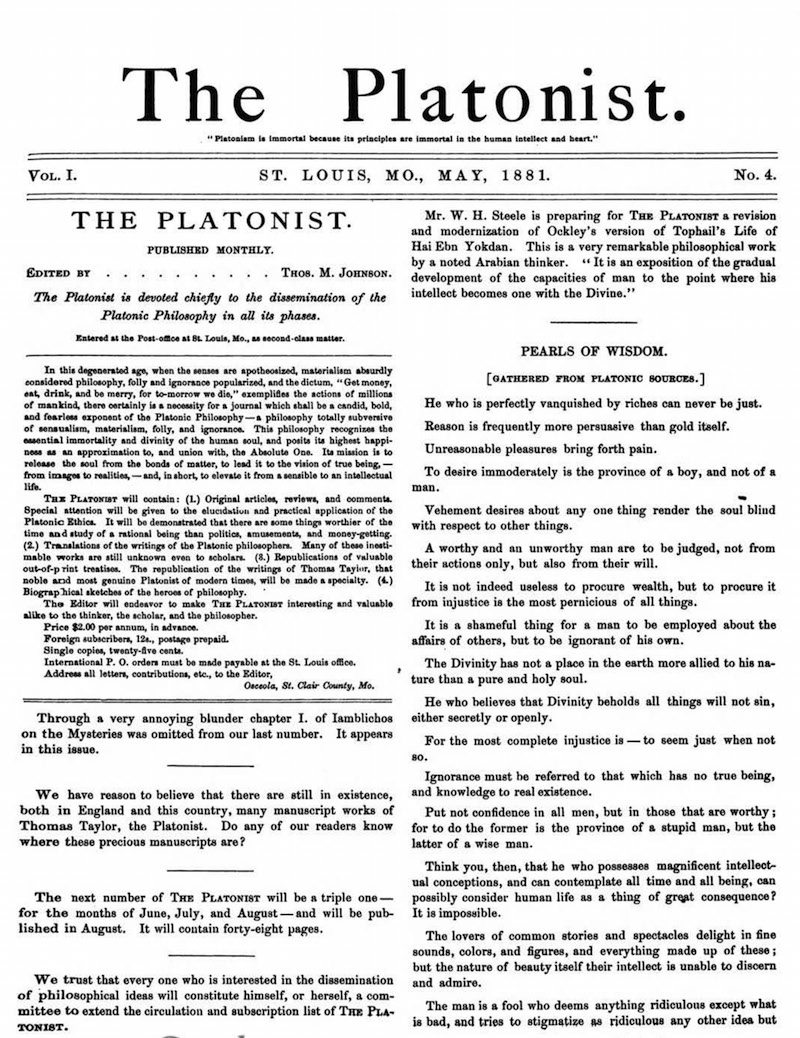
Platonist, The. Johnson (1851-1919) was an eminent attorney whose grand house still stands on the shores of the Lake of the Ozarks in Osceola, Missouri, and whose collection of early printed editions of classical and Neoplatonic works has been given to the University of Missouri. He was for a time the president of the American Central Council of the H.B. of L., and figures prominently in Paul Russell Anderson's Platonism in the Midwest (Philadelphia: Temple University Publications, 1963). The journal included translations of Plato and his Neoplatonic commentators, Greek, Persian and Arabic, and studies of Thomas Taylor, the Alexandrian School, and the like. "In this degenerated age, when the senses are apotheosized, materialism absurdly considered philosophy, folly and ignorance popularized, and the dictum, 'Get money, eat, drink, and be merry, for to-morrow we die,' exemplifies the actions of millions of mankind, there certainly is a necessity for a journal which shall be a candid, bold, and fearless exponent of the Platonic Philosophy — a philosophy totally subversive of sensualism, materialism, folly, and ignorance. This philososophy recognizes the essential immortality and divinity of the human soul, and posits its highest happiness as an approximation to, and union with, the Absolute One. Its mission is to release the soul from the bonds of matter, to lead it to the vision of true being, — from images to realities, — and, in short, to elevate it from a sensible to an intellectual life.' The journal also, especially after volume 1, published articles, thought by Johnson to relate to Platonism by way of Hermeticism or to reflect the "esoteric doctrine of all religions," by W.Q. Judge of the Theosophical Society (on whose American Board of Control Johnson sat), Alexander Wilder (the perennial Platonist), and by T.H. Burgoyne, C.H.A. Bjerregaard, Henry Wagner, and other fellow members of the H.B. of L., and translations of the Yoga Aphorisms of Patanjali, The Desatir, etc. One of the journal's few ads was for the Gnostic, published by Anna Kimball and George Chainey, who were also members of the H.B. of L. Although it now seems commonplace for occultism to position itself in the spectrum of ancient wisdom and the prisci theologi, the idea was a challenge to spiritualist orthodoxy at the time. The Banner of Light, March 5, 1881, in noting the new journal, wondered aloud why there was any need for "dead metaphysics" when the world had spiritualism. In May 1888 the journal announced that no. 7, which was supposed to appear in July, would appear in the fall, but no more were ever published. Instead, Bibliotheca Platonica, intended as convenient reprints of the Platonic writings, began to appear in July 1889. In 1919, K.S.L. Guthrie announced in The Romance of Two Centuries his intention to revive the Platonist in homage to Johnson, to include translations by him and articles on psychical experiences, all published with the goal of starting a Platonic Society, but nothing seems to have come of the idea. |
|
| LOC. | |
| Platonist V1 N1 1881 Feb | |
| Platonist V1 N2 1881 Mar | |
| Platonist V1 N3 1881 Apr | |
| Platonist V1 N4 1881 May | |
| Platonist V1 N5-7 1881 Jun-aug | |
| Platonist V1 N8-10 1881 Sep-nov | |
| Platonist V1 N11-12 1881 Dec-1882 Jan | |
| Platonist V2 N1 1884 Jan | |
| Platonist V2 N2 1884 Feb | |
| Platonist V2 N3 1884 Mar | |
| Platonist V2 N4 1884 Apr | |
| Platonist V2 N5 1884 May | |
| Platonist V2 N6 1884 Jun | |
| Platonist V2 N7 1884 Jul | |
| Platonist V2 N8 1885 Aug | |
| Platonist V2 N9 1885 Sep | |
| Platonist V2 N10 1885 Oct | |
| Platonist V2 N11 1885 Nov | |
| Platonist V2 N12 1885 Dec | |
| Platonist V3 N1 1887 Jan | |
| Platonist V3 N2 1887 Feb | |
| Platonist V3 N3 1887 Mar | |
| Platonist V3 N4 1887 Apr | |
| Platonist V3 N5 1887 May | |
| Platonist V3 N6 1887 Jun | |
| Platonist V3 N7 1887 Jul | |
| Platonist V3 N8 1887 Aug | |
| Platonist V3 N9 1887 Sep | |
| Platonist V3 N10 1887 Oct | |
| Platonist V3 N11 1887 Nov | |
| Platonist V3 N12 1887 Dec | |
| Platonist V4 N1 1888 Jan | |
| Platonist V4 N2 1888 Feb | |
| Platonist V4 N3 1888 Mar | |
| Platonist V4 N4 1888 Apr | |
| Platonist V4 N5 1888 May | |
| Platonist V4 N6 1888 Jun |
|
|